Episodi

  • Chicago’s Next Mayor? George Cardenas on Algorithms, Assessments, and Who Owns AI in City Hall
    Sep 18 2026

    What does a mayor actually do about artificial intelligence?

    George A. Cardenas is Chairman and Commissioner of the Cook County Board of Review and a candidate for mayor of Chicago.

    He came to Chicago from Durango as a boy, went to Lane Tech, joined the Navy to pay for school, and audited Fortune 500books before spending nearly twenty years as alderman of the 12th Ward.

    He now runs the office that hears roughly a quarter of a million property tax appeals a year.

    In this conversation he becomes the first candidate in the 2027 field to commit to a structure: a chief of AI and a digital transformation officer inside his first hundred days, working with the CIO, corporation counsel, the inspectorgeneral and procurement, and accountable to the mayor.

    "Within my first hundred days, I would designate a chief of AI and a digital transformation officer, that would be working with the current CIO and corporation counsel and the inspector general and procurement and operating departments, and ultimately to be accountable to the mayor. To me. For thatimplementation."

    Mostra di più Mostra meno
    50 min
  • Who Decides Which AI Risks Matter? Nick Diakopoulos on Media, Politics, and AI Governance
    Aug 24 2026

    Which AI risks end up in legislation, and where does that ranking come from?

    Nick Diakopoulos has spent a decade on that question. He is a professor of communication studies and, by courtesy, computer science at Northwestern University, where he directs the Computational Journalism Lab.

    He put the phrase "algorithmic accountability reporting" into circulation in a 2013 essay for The Atlantic and a 2014 Tow Center report, and his book Automating the News: How Algorithms Are Rewriting the Media (Harvard University Press, 2019) won the Tankard Book Award.

    In this conversation he walks through two studies. The first analyzed 42,853 news articles across 27 countries to measure which AI harms actually get covered: societal risk dominates at roughly half of all coverage, legal and rights harms take about a third, and existential risk finishes fifth at 7%.

    The second, presented at AAAI/ACM's AI, Ethics, and Society conference in 2025, narrows to US outlets and finds that risk coverage sorts by political lean — right-leaning outlets emphasizing malicious use, left-leaning outlets emphasizing socioeconomic and environmental harm, and both using the word "discrimination" to describe different phenomena.

    The conclusion is uncomfortable and hard to dismiss: AI risk assessment inherits the politics of the information reaching the people who write the rules.

    Mostra di più Mostra meno
    48 min
  • Notice as Data Infrastructure: Inside Illinois's 2026 AI Hiring Law
    Jun 22 2026

    When Illinois decided to regulate AI in hiring, it skipped the standard playbook. It passed no standalone AI statute and mandated no bias audit.

    Instead, it amended the sixty-year-old Illinois Human Rights Act, making algorithmic discrimination a civil rights matter and enforced by the same agency that handles housing, credit, and employment complaints.

    House Bill 3773 took effect January 1, 2026.

    Jason Rosensweig is one of the few people in the country writing the rules that will govern it. As Senior Policy Advisor at the Illinois Department of Human Rights, he's drafting the implementing regulations — Subpart J — that will shape how thousands of Illinois employers, and the vendors selling into them, operate.

    We get into:

    • Why Illinois built the law on a civil rights chassis, and how that decision determines which doctrines apply and what evidence courts will demand
    • How a single-issue bill about zip codes grew into a statewide notice regime
    • Why the compliance mechanism is disclosure rather than an audit — and how the notice doubles as data infrastructure for future enforcement
    • The "influence or facilitate" standard, and why its reach covers far more of the employment lifecycle than most compliance teams have scoped for
    • Why liability sits with employers rather than the developers who build the tools, and how Illinois vendor contracts are about to change in 2026
    • Jason's blunt response to the claim that AI moves too fast for government to regulate

    Jason holds a PhD from the University of Chicago's Committee on Social Thought and also teaches in the Northwestern Prison Education Project.

    Mostra di più Mostra meno
    55 min
  • Chicago's Next Mayor? Susana Mendoza on Fiscal Crisis, AI, and Why City Hall Needs a Builder
    Apr 1 2026

    Illinois Comptroller Susana Mendoza inherited a $16.7 billion bill backlog, a credit rating one notch above junk, and a rainy day fund with $48,000. Nine years later: ten credit upgrades, a $2.4 billion rainy day fund, and a payment cycle cut from 210 days to 13.

    Now, as she eyes a 2027 Chicago mayoral bid, she sits down with AI in Chicago to talk about what fiscal crisis management teaches us about the AI transition — why labor displacement could trigger the next revenue crisis, why transparency infrastructure is a prerequisite for AI in government, and why Chicago's next mayor needs to be a builder, not a bystander.

    Mostra di più Mostra meno
    50 min
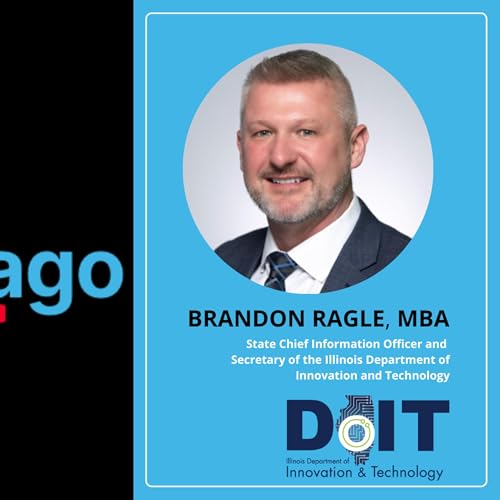
  • Responsible AI Scaling With Illinois State CIO and Secretary of the Illinois Department of Innovation and Technology Brandon Ragle
    Mar 9 2026

    In this episode of AI in Chicago, I sit down with Brandon Ragle, Illinois State Chief Information Officer and Secretary of the Illinois Department of Innovation and Technology, to talk about what it really takes to scale AI responsibly in a large public-sector organization.

    Brandon leads more than 1,800 technologists, manages a technology portfolio of over 11 billion dollars, and supports 3636 executive branch agencies serving 1313 million Illinois residents. Our conversation explores why strong foundations matter more than speed when adopting AI — from identity and access management to data governance, cybersecurity, workforce readiness, and long-term change management.

    We also discuss Illinois’ governance-first AI strategy, the state’s rollout of secure productivity tools, and why Brandon believes AI should enhance people’s work, not replace them. If you’re a leader thinking about AI adoption in government, healthcare, or any complex organization, this episode offers a practical blueprint for doing it right.

    Mostra di più Mostra meno
    45 min
  • Building a Quantum Workforce in Illinois: Why Business Leaders Should Pay Attention Now
    Feb 19 2026

    In this episode we talk to Harley Johnson, CEO of the Illinois Quantum and Microelectronics Park.

    Most business leaders have quantum computing filed away in the "maybe in 10–15 years" folder. After sitting down with Harley Johnson, the CEO of the Illinois Quantum and Microelectronics Park (IQMP), for the latest episode of the AI in Chicago Podcast, I'm convinced that timeline needs to be moved up. Significantly.

    Timed to the federal CHIPS and Science Act, a group of state and institutional leaders developed a deliberate strategy: take the basic science excellence Illinois had been building for a decade and translate it into economic development. The result is IQMP — a state-backed technology park being built on a former steel mill site on Chicago's South Side, designed to take quantum technology from lab breakthroughs to real-world scale.

    Mostra di più Mostra meno
    46 min
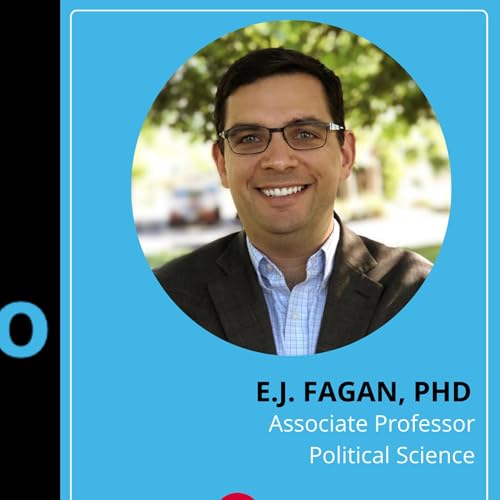
  • The Information War: How Think Tanks Fractured American Democracy (with Prof. E.J. Fagan)
    Feb 4 2026

    Why do Republicans and Democrats live in different factual universes? The answer traces back to 1973 and three conservative staffers who transformed how America makes policy.

    Professor E.J. Fagan, author of "The Thinkers," explains how partisan think tanks replaced neutral expertise with competing knowledge regimes—and why smart, educated people are actually easier to fool than everyone else.

    In this conversation, we explore:

    • Why the Heritage Foundation was founded and how it changed American politics

    • How the 2009 stimulus bill demonstrates the cost of ideological capture

    • Why it's easier to fool intelligent, motivated people than those who are less informed

    • The difference between think tanks in the US versus other democracies

    • Why Project 2025 may be less influential than people think

    • Organizations like the Niskanen Center and R Street Institute that are getting it right

    Professor Fagan argues the solution isn't neutral centrism;' it's politically engaged organizations with epistemic integrity.

    As we face decisions about AI deployment, climate adaptation, and economic transformation, we need information infrastructure that serves democracy.

    Key insight: "Don't try to take the politics out of information, but try to get it right."


    Guest: Professor E.J. Fagan, Associate Professor of Political Science at the University of Illinois Chicago and author of "The Thinkers: The Rise of Partisan Think Tanks and the Polarization of American Politics" (Oxford University Press)

    Mostra di più Mostra meno
    1 ora e 4 min
  • Downtown Isn't Dying; It's Evolving | Michael Edwards, CEO of the Chicago Loop Alliance
    Jan 29 2026

    Michael Edwards has spent 35 years leading downtown organizations across America. In his final months as CEO of the Chicago Loop Alliance, he joins the podcast to discuss downtown narratives in the age of AI with Khullani Abdullahi.

    He challenges the dominant narrative about urban decline. The data tells a different story: 1.2 million people visited the Loop for arts and culture in Q4 2025, spending $512 million.

    Weekend foot traffic now exceeds pre-pandemic levels. We discuss the shift from office occupancy as the defining metric, why Chicago's arts patrons visit five times more often than the national average, and how 145,000 Loop residents are reshaping the economic calculus of downtown living.

    Mostra di più Mostra meno
    42 min