AI for Good: Transforming Communities GoodSam Podcast • Inspiring Hope with Douglas Liles copertina

AI for Good: Transforming Communities GoodSam Podcast • Inspiring Hope with Douglas Liles

AI for Good: Transforming Communities GoodSam Podcast • Inspiring Hope with Douglas Liles

Di: A.I. Powered Hope with Douglas Liles
Ascolta gratuitamente

3 mesi a soli 0,99 €/mese

Dopo 3 mesi, 9,99 €/mese. Si applicano termini e condizioni.

A proposito di questo titolo

🌟 GoodSam: Where AI Meets Social Impact | Journey into the world of transformative technology changing lives and communities. Each episode explores groundbreaking AI innovations in healthcare, education, and sustainability, featuring tech visionaries and community leaders. From ethical AI to smart cities, discover how artificial intelligence is building a more equitable world. Perfect for innovators, changemakers, and anyone passionate about tech for good. Get exclusive insights on green tech, digital transformation, and grassroots innovations that matter. #AIForGood #TechForChange #GreenTechA.I. Powered Hope with Douglas Liles Politica e governo
  • What Is Neuromorphic Computing and Why Does It Matter?
    Dec 21 2025

    Neuromorphic computing is an approach to processor design that mimics the structure and function of biological neural networks, using analog circuits and spiking patterns instead of traditional digital logic. Unlike conventional computers that separate memory and processing (the Von Neumann architecture), neuromorphic chips perform computation directly within memory arrays, eliminating the data-transfer bottleneck that limits modern AI efficiency.

    The practical significance is energy efficiency. Traditional deep learning models consume enormous power during both training and inference. Data centers running AI workloads consume megawatts of electricity. Brain-inspired chips target the efficiency of biological neurons, which process information using approximately 20 watts for the entire human brain. This efficiency advantage makes neuromorphic computing critical for edge AI applications, autonomous systems, and sustainable AI infrastructure.

    Mostra di più Mostra meno
    14 min
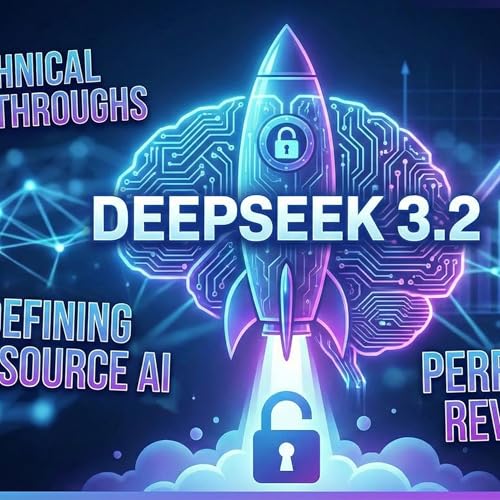
  • DeepSeek_3.2_Sparse_Attention_Changes_Agent_Economic
    Dec 15 2025

    detailed overview of the DeepSeek-V3.2 large language model, positioning it as an open-weight solution specifically engineered for agentic workloads. Its key architectural innovation is DeepSeek Sparse Attention (DSA), which efficiently manages extremely long 128K context windows by only attending to a small, relevant subset of tokens, dramatically reducing computational costs from O(L²) to O(L·k). The model also relies on scaled reinforcement learning and extensive agentic task synthesis to enhance reasoning and generalization, addressing historical weaknesses in open models regarding robust agent behavior. Operationally, the model is designed to be economically disruptive, with its release tied to 50%+ API price cuts, enabling developers to run complex, long-horizon agent loops that were previously too expensive.

    Mostra di più Mostra meno
    15 min
  • DeepSeek_3.2_AI_Half_Cost_Breakthrough
    Dec 15 2025

    Architecture, performance, and impact of DeepSeek 3.2, a new open-source large language model that aims to redefine efficient AI development. The model achieves benchmark performance comparable to frontier proprietary systems like GPT-5 and Claude 4.5 Sonnet, while operating at significantly lower computational cost, primarily through the introduction of DeepSeek Sparse Attention. This novel attention mechanism dramatically reduces resource usage by retaining only the approximately 2,000 most relevant tokens, regardless of the total input length. DeepSeek 3.2 also introduces sophisticated training innovations, including an unprecedented allocation of its compute budget to reinforcement learning (RL), alongside techniques like mixed RL training and keep routing operations to maintain stability in its mixture-of-experts (MoE) architecture. The release is positioned as evidence that the AI industry is shifting from an "age of scaling" to an "age of research," prioritizing architectural efficiency over raw compute to achieve state-of-the-art results. The model’s known limitations, such as verbose output and reduced breadth of world knowledge, are also acknowledged in comparison to more extensively trained closed-source competitors.

    Mostra di più Mostra meno
    13 min
Ancora nessuna recensione