• Episode 95 - Conclusion - How to Win the War on Waste in 90 Days - Audio Book
    Sep 8 2021

     SUMMARY (The 90 Day Schedule)

    How to  win the War on Waste in 90 days?


    Having read the book, you can now ask me again: “How can I win the War on Waste in 90 Days?”

    First of all, you sign up with me.[1]  Or do it on your own with a consulting phone support from me.  Or you just do it and if you get in trouble, call me.

    It really is pretty easy to do.

    I also have training manuals that you can buy to follow the program.

    Calendar    Action to be Accomplished.

    Day 1         Just get started on an 8 week program (4 days a week)
    Class Day 1 - During these  first 16 workdays each team goes thru the War on Waste 6 steps.  It isn’t a lot of time but it is enough time.  It isn’t about being precise; it is totally about making your point.

    Day 29       Presentations to management:
    Class Day 17 (Note that the Calendar day is a running clock, while class day is only while an employee is in class)  - All participating employees make their presentations to the CEO or local managing director.

    Just listen to the rest of the process and you will appreciate how direct and simple this whole process is.  Just focus.  Best, Len


    [1] Len Bertain, Bertain Consulting Group, len@bertain.com, Cell: 510-520-8011.

    Mostra di più Mostra meno
    20 min
  • Episode 94 - Chapter 11 - How to Win the War on Waste in 90 Days - Audio Book
    Sep 8 2021

    The 7 things listed below are items that you need to do to make the War on Waste work successfully.

    1. Begin the 6 Steps of the War on Waste! Of course, that is what this whole process is about.   Start it up and stand back.  This is really a fun process.
    2. Use the tools of the War on Waste. Tools of the War on Waste were explained throughout the book. Chapters 7, 8, and 9 describe a number of tools that we use extensively as we deliver the War on Waste. 
    3. Check in often with each team personally. Do this before they do their presentations. You need time to digest their suggestion and maybe even to think of things to make their project work better and more cost effectively.d
    4. Push the teams. People who have done the War on Waste with my remote support have all said that they didn’t push the teams hard enough to get their projects ready for the presentation day. 
    5. Integrate your Mission Statement. You want to follow the guide defined in the process. Each idea needs to be weighed against the Mission Statement. 
    6. Integrate 5/67 tThinking into your daily routine. We absolutely believe that the 5/67 Rule is an important tool to be used in key management decisions. Understand what I wrote about it earlier and take it seriously. 
    7. Set up the TKC. As I noted earlier, I don’t care what you call it but set up a center where ideas can be collected. The concepts that are described in Chapter 9 may help you set it up. Just do it. 

    I hope you find this book of value, but I still have one more task to do, and that is to show you the time line of How You Win the War on Waste in 90 Days.

    Mostra di più Mostra meno
    12 min
  • Episode 93 - Chapter 10 - How to Win the War on Waste in 90 Days - Audio Book
    Sep 8 2021
    10.  FAQs


    Have you ever done a company like ours?

    This is one of the most interesting questions that I get asked.  The answer is pretty easy.  Probably not or if I did one like yours, it still wasn’t yours.  And that doesn’t matter a bit.

    The War on Waste is about fixing a company’s processes.  It doesn’t make any difference what business you are in, the first question that we ask in the program is, “What do you do here to make money?”

    That is what determines waste in the company.  If for instance you are a bank or finance company, this is not an easy answer.  Do you make it only when you take in savings of your customers and invest them?  Or are there other things that you do?  

    So getting clear on this is the very first thing you do in the War on Waste.  Once you know how the company makes money, then the whole process flows from there.

    Other questions: 

    When can I ever do the War on Waste?

    How much does it cost?

    Of course there are a hundred questions that we get asked but the bottom line is the target of 50 to 1 for small companies and 100 to 1 for large companies worth it.  If we can do that all day long, the War on Waste is a good deal.

    Mostra di più Mostra meno
    7 min
  • Episode 92 - Chapter 9 - How to Win the War on Waste in 90 Days - Audio Book
    Sep 8 2021
    9.  The TKC


    The War on Waste creates the ideas and a process to get ideas into play.  But it still requires a formal process to get new ideas into the system.  Once the War on Waste is completed, the company still wants new ideas to continue.  When the War on Waste is over, the implemented ideas need to be tracked.  That is achieved with the Tribal Knowledge Council, the subject of this chapter.

    The TKC is the control point for the input of all ideas.  Its purpose is to be the clearing-house for change and new ideas.  It serves as a touchstone for the CEO and his Executive team.  They use it to keep track of ideas as they move through the system. 

    It is not managed as much as it is a monitor.  It is an automated function with a dashboard.  The dashboard tracks the progress of results.

    A word of caution here: this council has no direct authority.  Nor should it.  It merely facilitates the process of putting ideas into play.  If authority is given, it will create two problems.  One, it will conflict with line management authority.  And two, it will create an artificial elite status.  This will dampen participation.

    Just a note: I wrote this book 10 years ago and had not gotten my on-line business going.  With the on-line business, there is a demand for an opportunity to participate in the program and so the management of the ideas using the TKC is no longer required.  The system morphs in response to new ideas and continuously does so.  It has been an amazing process.  Try it out: email me at len@copsolvers.com.  Best, Len


    Mostra di più Mostra meno
    10 min
  • Episode 91 - Chapter 8 - How to Win the War on Waste in 90 Days - Audio Book
    Sep 8 2021
    8.  Strategy 

     
    This is not a chapter to compete with other treatises on strategy.  There are a number of great tomes on the subject.  This chapter is merely to place it in context within the War on Waste.  

    The War on Waste led to the idea that strategy became aligned with process in the program.  We referenced Michael Porter,[1] who is the pre-eminent strategy scholar in the United States.  But this observation is not Porter’s.  It is ours.  

     This came out of our field research.  It was a remarkable outcome.  And we didn’t see it coming.  But it happened with all of our clients.  Now, it serves as one of the anchor tenets of the paradigm.  We would like to explore that a bit.  

    Who cares about this?  Why is this important?  To answer these questions let us get back to basics.


    [1] Op. Cit., Porter, p 11 


    Mostra di più Mostra meno
    16 min
  • Episode 90 - Chapter 7 - How to Win the War on Waste in 90 Days - Audio Book
    Aug 5 2021
    7.  Tools of the War


    Over the years, we used tools of the trade in unique ways.  We borrowed tools from friends.  And we made up our own tools.  Some of these are worth noting. 

    120/20 Rule of Profits.

    There is a corollary to the 80/20 Rule.  A business “turn around” consulting friend showed us this rule.  We have all seen it.  It is the 120/20 Rule of Profits. 

    ·      120% of a company’s profits come from 20% of the customers.  

    ·      120% of profits from 20% of the salesmen.

    ·      120% of the profits from 20% of the products or services.   

    We call it the Bibeault 120/20 Rule of Profits, in honor of our consultant friend who pointed it out to us.[1]  This rule is a good tool to develop an effective customer-driven strategy.  It allows us to focus attention on those customers, salesmen or products that deliver the most profit.  It may also help understand why.  Why are some more profitable?

    The 5/67 Rule ­(1 Sigma)

    The 5/67 Rule is a subset of the 20/80 Rule or 80/20 Rule.  We discovered it during the War on Waste.  We were always in a hurry to get projects completed and we didn’t have time to look at 20% of the problem demanded by the 20/80 Rule.  But we did have time to look at 5% of the problem.  When we did that we kept seeing that we were getting about 60 to 70% of the targeted benefit.  We called it the 5/67 Rule without really knowing much about it.  It just seemed to work but it didn’t make sense.  

    Yes/No Charts
    Our unique tool to measure and guide problem behavior (like things happening late).

    World Record Reports

    A unique way to achieve continuous improvement.

    [1] Don Bibeault is a venture capital investor now.  In his former life, he was management consultant. He specialized in turning around distressed companies.  


    Mostra di più Mostra meno
    15 min
  • Episode 89 - Chapter 6 - How to Win the War on Waste in 90 Days - Audio Book
    Aug 5 2021
    6.  Value-adding

     
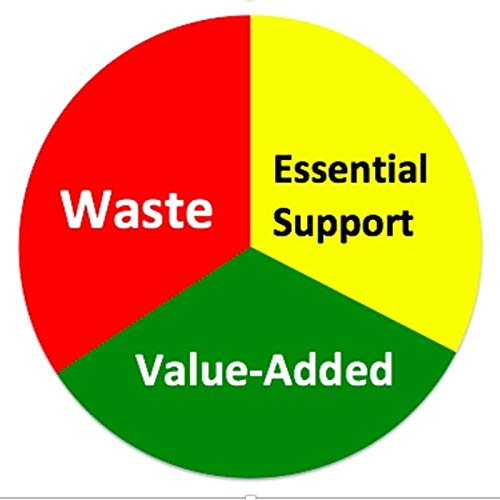
    There are a number of ways to define this term.  We define it simply as “what customers are willing to pay for.”  In any business, everyone needs to understand why the business exists and how it makes money.  As we do the War on Waste, we ask a very simple question, “What does this company do to add value?”  The answer to this simple question serves as the basis for the War on Waste.

    So the question “what is waste” is intimately tied to the company’s value-added activity.  There is an interesting thing that happens in the War on Waste.  As employees start to identify waste, they are reflecting the effectiveness of a company’s ability to deliver value.  All those things that occur in a company that keep the value from being added efficiently are wastes.  During the War on Waste, we look at a company’s value-added proposition very closely.  And the process for doing that is very thorough.

    What we have found out is that very few employees of companies have any clue as to what the company does to add value.  When we ask a typical employee of a machine shop, “What does this company do to add-value?” it is amazing that most of them have never thought about it.  After a few minutes of discussion, someone notes that it is obvious that a machine shop makes money only one-way: when chips are being produced.  But then some wise guy asks if they are adding value when they do assemblies for their customers.  Of course, they do.  Customers are paying a small fee for the assembly.  And then one of the ladies in the quality department asks “what about our military customers that also pay to inspect their parts?”  Best, Len Bertain


    Mostra di più Mostra meno
    10 min
  • Episode 88 - Chapter 5 - How to Win the War on Waste in 90 Days - Audio Book
    Aug 4 2021

     5.  Using the Mission Statement

    We made an observation early on.  It wasn’t a life changing experience but it was part of many of our conversations.  We noted that the Mission Statement is rarely involved in decision-making.  Once a few bright MBAs put a Mission Statement together, it goes somewhere to die.  It just isn’t involved in the daily routine.

    So we wondered why?  Why is so much time spent on developing a “Mission Statement” and it isn’t actively used in running the business?  It is almost as if it were part of a checklist for executives.  It is the third thing on the list every CEO must do: Do we have a Mission Statement?  If so, “go to the next item.  If not, make one.”

    We actually thought that many of the Mission Statements that we had seen were pretty good.  They weren’t perfect but they were good starting points.  So why weren’t they used to guide business decisions.  They could somehow be part of a touchstone that related a decision to the Mission of the company.    Enjoy.  Len

    Mostra di più Mostra meno
    9 min