

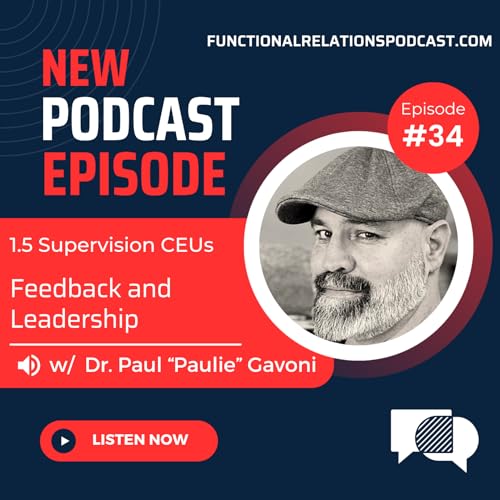
#34 - Feedback and Leadership w/ Dr. Paul "Paulie" Gavoni
Impossibile aggiungere al carrello
Puoi avere soltanto 50 titoli nel carrello per il checkout.
Riprova più tardi
Riprova più tardi
Rimozione dalla Lista desideri non riuscita.
Riprova più tardi
Non è stato possibile aggiungere il titolo alla Libreria
Per favore riprova
Non è stato possibile seguire il Podcast
Per favore riprova
Esecuzione del comando Non seguire più non riuscita

#34 - Feedback and Leadership w/ Dr. Paul "Paulie" Gavoni
-
Letto da:
-
Di:
A proposito di questo titolo
In this episode, Zach and Caleb discuss feedback and leadership with Dr. Paul "Paulie" Gavoni.
- 1.5 Supervision CEs (BACB, IBAO, and/or QABA) are available for this episode. You can purchase them at https://www.functionalrelationspodcast.com
- Become a member to get access to our entire library of CEs and access exclusive behind the scenes content for $79/yr. https://www.functionalrelationspodcast.com/subscription/membership
Dr. Gavoni's Digital Business Card
Some of Dr. Gavoni's books:
The Feedback Effect: Lead Smarter, Not Harder With the Science of Human Behavior
Adaptive Intelligence: The Evolution of Emotional Intelligence Through the Proven Power of Behavior Science
Positional Authority Ain't Leadership: Behavioral Science for Navigating Bull$hit, Optimizing Performance, and Avoiding A$$ Clownery
Deliberate Coaching: Optimizing Teaching and Learning Through Behavior Science: Education Edition
The Feedback Effect: Lead Smarter, Not Harder With the Science of Human Behavior
References:
- Austin, J. (2000). Performance analysis and performance diagnostics. Handbook of applied behavior analysis, 321-349.
- Bukszpan, A. R., Leaf, J. B., O'Brien, J. G., Lewis, A., Kristiansen, S., Lord, J., ... & Weiss, M. J. (2025). Utilizing the Teaching Interaction Procedure to Train Special Education Teachers in Behavioral Artistry. Behavioral Interventions, 40(3), e70017.
- Green, D. R., Ferguson, J. L., Cihon, J. H., Torres, N., Leaf, R., McEachin, J., ... & Leaf, J. B. (2020). The teaching interaction procedure as a staff training tool. Behavior Analysis in Practice, 13(2), 421-433.
Ancora nessuna recensione