

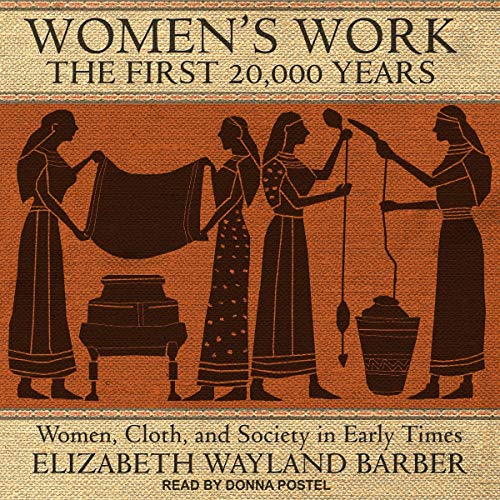
Women's Work
The First 20,000 Years: Women, Cloth, and Society in Early Times
Impossibile aggiungere al carrello
Rimozione dalla Lista desideri non riuscita.
Non è stato possibile aggiungere il titolo alla Libreria
Non è stato possibile seguire il Podcast
Esecuzione del comando Non seguire più non riuscita
0,99 €/mese per i primi 3 mesi

Women's Work
Acquista ora a 12,63 €
-
Letto da:
-
Donna Postel
New discoveries about the textile arts reveal women's unexpectedly influential role in ancient societies.
Twenty thousand years ago, women were making and wearing the first clothing created from spun fibers. In fact, right up to the Industrial Revolution the fiber arts were an enormous economic force, belonging primarily to women.
Despite the great toil required in making cloth and clothing, most books on ancient history and economics have no information on them. Much of this gap results from the extreme perishability of what women produced, but it seems clear that until now descriptions of prehistoric and early historic cultures have omitted virtually half the picture.
Elizabeth Wayland Barber has drawn from data gathered by the most sophisticated newer archaeological methods - methods she herself helped to fashion. In a "brilliantly original book" (Katha Pollitt, Washington Post Book World), she argues that women were a powerful economic force in the ancient world, with their own industry: fabric.
©1994 Elizabeth Wayland Barber (P)2019 Tantor