

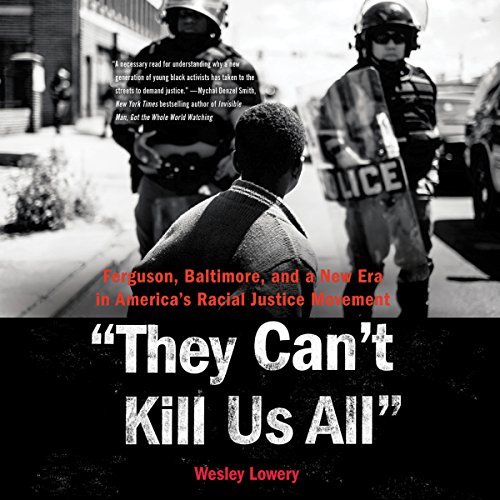
They Can't Kill Us All
Ferguson, Baltimore, and a New Era in America's Racial Justice Movement
Impossibile aggiungere al carrello
Puoi avere soltanto 50 titoli nel carrello per il checkout.
Riprova più tardi
Riprova più tardi
Rimozione dalla Lista desideri non riuscita.
Riprova più tardi
Non è stato possibile aggiungere il titolo alla Libreria
Per favore riprova
Non è stato possibile seguire il Podcast
Per favore riprova
Esecuzione del comando Non seguire più non riuscita
9,19 € per i primi 30 giorni
Offerte di stagione
0,99 €/mese per i primi 3 mesi
L'offerta termina il 28 dicembre 2026.
Dopo 30 giorni (60 per i membri Prime), 9,99 €/mese. Puoi cancellare ogni mese
Risparmia più del 90% nei primi 3 mesi.
Ascolta quanto vuoi, scegliendo tra migliaia di audiolibri e serie originali inclusi.
Scarica il tuo audiolibro e ascolta offline, senza interruzioni
Rinnovo automatico a 9,99 €/mese dopo 3 mesi. Disdici mensilmente. L'offerta termina il 28 dicembre 2026.
Dopo esserti registrato per un abbonamento, puoi acquistare questo e tutti gli altri audiolibri nel nostro catalogo esteso, ad un prezzo scontato del 30%
Ottieni accesso illimitato a una raccolta di oltre migliaia di audiolibri e podcast originali.
Nessun impegno. Cancella in qualsiasi momento e conserva tutti i titoli acquistati.

They Can't Kill Us All
Letto da:
Ron Butler
Acquista ora a 13,26 €
-
Letto da:
-
Ron Butler
-
Di:
-
Wesley Lowery
Conducting hundreds of interviews during the course of over one year reporting on the ground, Washington Post writer Wesley Lowery traveled from Ferguson, Missouri, to Cleveland, Ohio; Charleston, South Carolina; and Baltimore, Maryland; and then back to Ferguson to uncover life inside the most heavily policed, if otherwise neglected, corners of America today.
In an effort to grasp the magnitude of the repose to Michael Brown's death and understand the scale of the problem police violence represents, Lowery speaks to Brown's family and the families of other victims other victims' families as well as local activists. By posing the question, "What does the loss of any one life mean to the rest of the nation?" Lowery examines the cumulative effect of decades of racially biased policing in segregated neighborhoods with failing schools, crumbling infrastructure and too few jobs.
Studded with moments of joy, and tragedy, They Can't Kill Us All offers a historically informed look at the standoff between the police and those they are sworn to protect, showing that civil unrest is just one tool of resistance in the broader struggle for justice. As Lowery brings vividly to life, the protests against police killings are also about the black community's long history on the receiving end of perceived and actual acts of injustice and discrimination.
They Can't Kill Us All grapples with a persistent if also largely unexamined aspect of the otherwise transformative presidency of Barack Obama: the failure to deliver tangible security and opportunity to those Americans most in need of both.
adbl_web_anon_alc_button_suppression_t1
Recensioni della critica
"Lowery's book is electric, because it is so well reported, so plainly told and so evidently the work of a man who has not grown a callus on his heart.... Lowery's book is valuable for many reasons. He circles slowly and warily around the question of why, during Obama's presidency, so little has happened to improve on the racial front."--Dwight Garner, New York Times
"Lowery's dispatches from the front lines of this new era in racial justice movement building have proven indispensable, and with They Can't Kill Us All, he further shows just how vital his reporting has become. Part early history of a still growing movement, as well as part critique of the media charged with covering this movement, Lowery also offers a peek into the process of reporting--the structural challenges, unfortunate failures, and personal successes in accurately capturing the politics and personalities involved in the biggest domestic story of the Obama presidency. They Can't Kill Us All proves itself a necessary read for anyone in need of greater understanding of why and how a new generation of young black activists have taken to the streets to demand justice from their country.—Mychal Denzel Smith, New York Times bestselling author of Invisible Man, Got the Whole World Watching
"Lowery's dispatches from the front lines of this new era in racial justice movement building have proven indispensable, and with They Can't Kill Us All, he further shows just how vital his reporting has become. Part early history of a still growing movement, as well as part critique of the media charged with covering this movement, Lowery also offers a peek into the process of reporting--the structural challenges, unfortunate failures, and personal successes in accurately capturing the politics and personalities involved in the biggest domestic story of the Obama presidency. They Can't Kill Us All proves itself a necessary read for anyone in need of greater understanding of why and how a new generation of young black activists have taken to the streets to demand justice from their country.—Mychal Denzel Smith, New York Times bestselling author of Invisible Man, Got the Whole World Watching
"Riveting.... A timely, significant book."
—Kirkus, Starred Review
—Kirkus, Starred Review
"With empathy, anguish, and a superb eye for telling detail, Wesley Lowery chronicles the birth of the new civil rights movement. This book is an urgent, grounds-eye view of the struggle."
—Chris Hayes, author of A Colony in a Nation
—Chris Hayes, author of A Colony in a Nation
"They Can't Kill Us All is a wise memoir that chronicles the fatigue of reporting Black death at the hands of law enforcement."
—Ebony
—Ebony
"Lowery takes us inside the pain and courage of those who have cared to challenge the police and this nation. He details their stories and, along the way, provides a powerful and all-too-human account of what it means to be a reporter in a time of profound crisis. His example gives me renewed home in those who report the news. This is a must read!"
—Eddie S. Glaude, Jr., author of Democracy in Black: How Race Still Enslaves the American Soul
—Eddie S. Glaude, Jr., author of Democracy in Black: How Race Still Enslaves the American Soul
"They Can't Kill Us All is a comprehensive record of the #blacklivesmatter protest movement, as well as a first-person account of those events from the author's dual--and conflicted--perspective as a journalist and an African-American man."
—Esquire
—Esquire
"[A] vital book.... Setting the fatal police shootings of young black men in the historical context of racial violence, Lowery also adds personal insight as a young biracial man professionally bound to the crisis."
—Elle
—Elle
Ancora nessuna recensione