

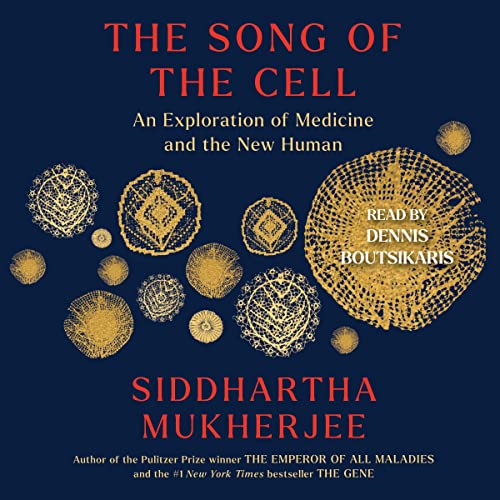
The Song of the Cell
An Exploration of Medicine and the New Human
Impossibile aggiungere al carrello
Puoi avere soltanto 50 titoli nel carrello per il checkout.
Riprova più tardi
Riprova più tardi
Rimozione dalla Lista desideri non riuscita.
Riprova più tardi
Non è stato possibile aggiungere il titolo alla Libreria
Per favore riprova
Non è stato possibile seguire il Podcast
Per favore riprova
Esecuzione del comando Non seguire più non riuscita
10,70 € per i primi 30 giorni
Offerte di stagione
0,99 €/mese per i primi 3 mesi
L'offerta termina il 28 dicembre 2026.
Dopo 30 giorni (60 per i membri Prime), 9,99 €/mese. Puoi cancellare ogni mese
Risparmia più del 90% nei primi 3 mesi.
Ascolta quanto vuoi, scegliendo tra migliaia di audiolibri e serie originali inclusi.
Scarica il tuo audiolibro e ascolta offline, senza interruzioni
Rinnovo automatico a 9,99 €/mese dopo 3 mesi. Disdici mensilmente. L'offerta termina il 28 dicembre 2026.
Dopo esserti registrato per un abbonamento, puoi acquistare questo e tutti gli altri audiolibri nel nostro catalogo esteso, ad un prezzo scontato del 30%
Ottieni accesso illimitato a una raccolta di oltre migliaia di audiolibri e podcast originali.
Nessun impegno. Cancella in qualsiasi momento e conserva tutti i titoli acquistati.

The Song of the Cell
Letto da:
Dennis Boutsikaris
Acquista ora a 15,28 €
-
Letto da:
-
Dennis Boutsikaris
Named a New York Times Notable Book and a Best Book of the Year by The Economist, Oprah Daily, BookPage, Book Riot, the New York Public Library, and more!
In The Song of the Cell, the extraordinary author of the Pulitzer Prize–winning The Emperor of All Maladies and the #1 New York Times bestseller The Gene traces the history of cell biology and its transformation of modern medicine in a book that “blends cutting-edge research, impeccable scholarship, intrepid reporting, and gorgeous prose into an encyclopedic study that reads like a literary page-turner” (Oprah Daily).
Mukherjee begins this magnificent story in the late 1600s, when a distinguished English polymath, Robert Hooke, and an eccentric Dutch cloth-merchant, Antonie van Leeuwenhoek looked down their handmade microscopes. What they saw introduced a radical concept that swept through biology and medicine, touching virtually every aspect of the two sciences, and altering both forever. It was the fact that complex living organisms are assemblages of tiny, self-contained, self-regulating units. Our organs, our physiology, our selves—hearts, blood, brains—are built from these compartments. Hooke christened them “cells.”
The discovery of cells—and the reframing of the human body as a cellular ecosystem—announced the birth of a new kind of medicine based on the therapeutic manipulations of cells. A hip fracture, a cardiac arrest, Alzheimer’s dementia, AIDS, pneumonia, lung cancer, kidney failure, arthritis, COVID pneumonia—all could be reconceived as the results of cells, or systems of cells, functioning abnormally. And all could be perceived as loci of cellular therapies.
Filled with writing so vivid, lucid, and suspenseful that complex science becomes thrilling, The Song of the Cell tells the story of how scientists discovered cells, began to understand them, and are now using that knowledge to create new humans. Told in six parts, and laced with Mukherjee’s own experience as a researcher, a doctor, and a prolific reader, The Song of the Cell is both panoramic and intimate—a masterpiece on what it means to be human.
“In an account both lyrical and capacious, Mukherjee takes us through an evolution of human understanding: from the seventeenth-century discovery that humans are made up of cells to our cutting-edge technologies for manipulating and deploying cells for therapeutic purposes” (The New Yorker).
adbl_web_anon_alc_button_suppression_t1
Recensioni della critica
"This is the second of Mukherjee’s audiobooks that Dennis Boutsikaris has narrated, after 2017’s THE GENE. In this expansive history of the researchers who unlocked the mysteries of the cell, Boutsikaris demonstrates again the importance of an experienced narrator in shaping a complex narrative. Using many of his skills as a narrator of bestselling thrillers, Boutsikaris shades a syllable here, adds a degree of emphasis there, heightening and bringing dramatic tension to a history that is already skillfully told and highly accessible but, at times, unavoidably dense. This is a narrative to digest slowly, step by step. The chapters are conveniently brief, and it’s no effort to listen to such an adept performer a second, even a third, time."
Ancora nessuna recensione