

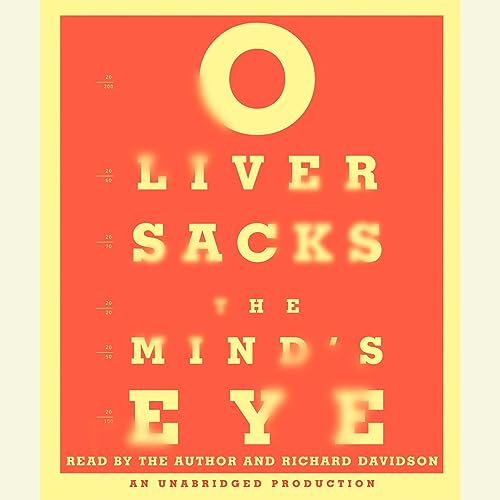
The Mind's Eye
Impossibile aggiungere al carrello
Puoi avere soltanto 50 titoli nel carrello per il checkout.
Riprova più tardi
Riprova più tardi
Rimozione dalla Lista desideri non riuscita.
Riprova più tardi
Non è stato possibile aggiungere il titolo alla Libreria
Per favore riprova
Non è stato possibile seguire il Podcast
Per favore riprova
Esecuzione del comando Non seguire più non riuscita
Attiva il tuo abbonamento Audible con un periodo di prova gratuito per ottenere questo titolo a un prezzo esclusivo per i membri
Dopo 30 giorni (60 per i membri Prime), 9,99 €/mese. Puoi cancellare ogni mese
Dopo esserti registrato per un abbonamento, puoi acquistare questo e tutti gli altri audiolibri nel nostro catalogo esteso, ad un prezzo scontato del 30%
Ottieni accesso illimitato a una raccolta di oltre migliaia di audiolibri e podcast originali.
Nessun impegno. Cancella in qualsiasi momento e conserva tutti i titoli acquistati.

The Mind's Eye
Letto da:
Oliver Sacks, Richard Davidson
Acquista ora a 12,63 €
-
Letto da:
-
Oliver Sacks
-
Richard Davidson
-
Di:
-
Oliver Sacks
There is Lilian, a concert pianist who becomes unable to read music and is eventually unable even to recognize everyday objects, and Sue, a neurobiologist who has never seen in three dimensions, until she suddenly acquires stereoscopic vision in her fifties.
There is Pat, who reinvents herself as a loving grandmother and active member of her community, despite the fact that she has aphasia and cannot utter a sentence, and Howard, a prolific novelist who must find a way to continue his life as a writer even after a stroke destroys his ability to read.
And there is Dr. Sacks himself, who tells the story of his own eye cancer and the bizarre and disconcerting effects of losing vision to one side.
Sacks explores some very strange paradoxes—people who can see perfectly well but cannot recognize their own children, and blind people who become hyper-visual or who navigate by “tongue vision.” He also considers more fundamental questions: How do we see? How do we think? How important is internal imagery—or vision, for that matter? Why is it that, although writing is only five thousand years old, humans have a universal, seemingly innate, potential for reading?
The Mind’s Eye is a testament to the complexity of vision and the brain and to the power of creativity and adaptation. And it provides a whole new perspective on the power of language and communication, as we try to imagine what it is to see with another person’s eyes, or another person’s mind.
adbl_web_anon_alc_button_suppression_t1
Recensioni della critica
A Financial Times Best Book
A Globe and Mail Best Book
A New York Times Notable Book
“Compelling. . . . Uplifting. . . . One more chance to bask in an extraordinary man’s irrepressible belief in the human potential to do more than survive the travails of our fragility.”
—Edmonton Journal
“Awe-inspiring. . . . A deeply moving book.”
—Norman Doidge, The Globe and Mail
“Graceful.”
—The New York Times Book Review (Editor’s Choice)
“Sacks invites readers to imagine their way into minds unlike their own, encouraging a radical form of empathy. . . . The Mind’s Eye expresses a stubborn hope.”
—Los Angeles Times
“Frank and moving. . . . His books resonate because they reveal as much about the force of character as they do about neurology.”
—Nature
“It is a measure of his artistry that Sacks slots such funk and anxiety into a book that’s mostly about the plasticity and adaptability of the human brain; a book that busily celebrates the indomitability of people.”
—The Telegraph
A Globe and Mail Best Book
A New York Times Notable Book
“Compelling. . . . Uplifting. . . . One more chance to bask in an extraordinary man’s irrepressible belief in the human potential to do more than survive the travails of our fragility.”
—Edmonton Journal
“Awe-inspiring. . . . A deeply moving book.”
—Norman Doidge, The Globe and Mail
“Graceful.”
—The New York Times Book Review (Editor’s Choice)
“Sacks invites readers to imagine their way into minds unlike their own, encouraging a radical form of empathy. . . . The Mind’s Eye expresses a stubborn hope.”
—Los Angeles Times
“Frank and moving. . . . His books resonate because they reveal as much about the force of character as they do about neurology.”
—Nature
“It is a measure of his artistry that Sacks slots such funk and anxiety into a book that’s mostly about the plasticity and adaptability of the human brain; a book that busily celebrates the indomitability of people.”
—The Telegraph
Ancora nessuna recensione