

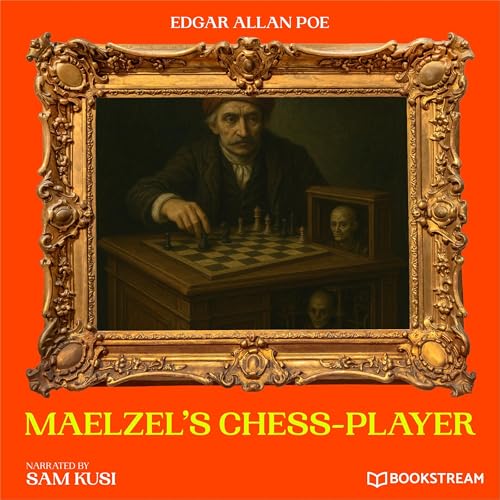
Maelzel's Chess-Player
Impossibile aggiungere al carrello
Rimozione dalla Lista desideri non riuscita.
Non è stato possibile aggiungere il titolo alla Libreria
Non è stato possibile seguire il Podcast
Esecuzione del comando Non seguire più non riuscita
0,99 €/mese per i primi 3 mesi

Maelzel's Chess-Player
Acquista ora a 7,04 €
-
Letto da:
-
Sam Kusi
-
Di:
-
Edgar Allan Poe
"Maelzel's Chess Player" (1836) is an essay by Edgar Allan Poe exposing a fraudulent automaton chess player called The Turk, which had become famous in Europe and the United States and toured widely. The fake automaton was invented by Wolfgang von Kempelen in 1769 and was brought to the U.S. in 1825 by Johann Nepomuk Mälzel after von Kempelen's death.
In his essay, Poe asserts that a mechanical chess player would play perfectly, but Maelzel's "machine" occasionally errs, and is therefore suspect. Although it is the most famous essay on the Turk, many of Poe's hypotheses were incorrect. He also may or may not have been aware of earlier articles written in the Baltimore Gazette where two youths were reported to have seen chess player William Schlumberger climbing out of the machine. He did, however, borrow heavily from David Brewster's Letters on Natural Magic. Other essays and articles had been written and published prior to Poe's in Baltimore, Philadelphia, and Boston—cities in which Poe had lived or visited before writing his essay.
©2026 Bookstream Audiobooks (P)2026 Bookstream Audiobooks