

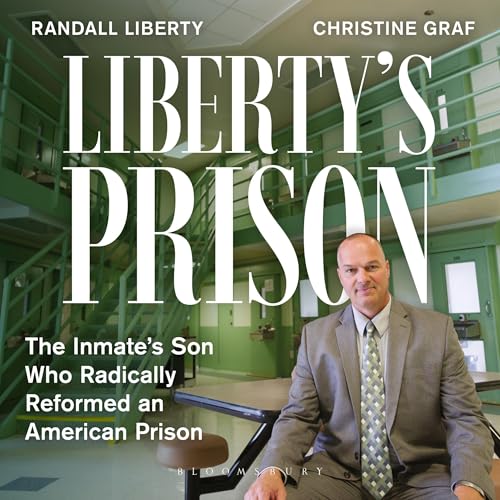
Liberty’s Prison
The Inmate’s Son Who Radically Reformed an American Prison
Impossibile aggiungere al carrello
Puoi avere soltanto 50 titoli nel carrello per il checkout.
Riprova più tardi
Riprova più tardi
Rimozione dalla Lista desideri non riuscita.
Riprova più tardi
Non è stato possibile aggiungere il titolo alla Libreria
Per favore riprova
Non è stato possibile seguire il Podcast
Per favore riprova
Esecuzione del comando Non seguire più non riuscita
11,76 € per i primi 30 giorni
Offerte di stagione
0,99 €/mese per i primi 3 mesi
L'offerta termina il 28 dicembre 2026.
Dopo 30 giorni (60 per i membri Prime), 9,99 €/mese. Puoi cancellare ogni mese
Risparmia più del 90% nei primi 3 mesi.
Ascolta quanto vuoi, scegliendo tra migliaia di audiolibri e serie originali inclusi.
Scarica il tuo audiolibro e ascolta offline, senza interruzioni
Rinnovo automatico a 9,99 €/mese dopo 3 mesi. Disdici mensilmente. L'offerta termina il 28 dicembre 2026.
Dopo esserti registrato per un abbonamento, puoi acquistare questo e tutti gli altri audiolibri nel nostro catalogo esteso, ad un prezzo scontato del 30%
Ottieni accesso illimitato a una raccolta di oltre migliaia di audiolibri e podcast originali.
Nessun impegno. Cancella in qualsiasi momento e conserva tutti i titoli acquistati.

Liberty’s Prison
Letto da:
Christopher Ragland
Acquista ora a 16,80 €
-
Letto da:
-
Christopher Ragland
When Randy Liberty was seven years old, he traveled to the Maine State Prison to visit his incarcerated father. Forty years later, he returned to the prison as its Warden. A trailblazer in the field of corrections, Randy introduced innovative programs and dramatically reduced the use of restrictive housing during his tenure as warden. In 2019, Randy was appointed commissioner of corrections, implementing an operating philosophy known as the Maine Model of Corrections. Representing a radical shift from traditional models of incarceration, it focuses on rehabilitation, redemption, de-stigmatization, and humanization. Statewide recidivism rates since dropped to twenty-one percent, well below the national average of sixty-five percent. This book tells Randy’s story, how he was able to break free from generational incarceration and poverty to achieve redemption and a life filled with purpose.©2026 Bloomsbury Publishing PLC (P)2026 Bloomsbury Publishing PLC
adbl_web_anon_alc_button_suppression_t1
Recensioni della critica
Readers with an interest in the criminal justice system will appreciate this aspect of Liberty’s Prison, where the author forcefully addresses how to fix the problems in the penal system.
Randy Liberty is one of America's most compelling voices in prison reform—and his unflinching memoir reveals how he got there. From the chaos of a violent childhood to becoming a national leader transforming our correctional system—one man's extraordinary journey proves that change is possible.
Liberty's story traces a path that defies every expectation. Raised in poverty with a father behind bars, he could have become another casualty of the system. Instead, he forged himself into a leader—first as a decorated Command Sergeant Major in Iraq, where he carried the weight of life-and-death decisions in combat, then as an elected county sheriff, rescue diver, prison warden, and eventually Commissioner of Corrections, in each role confronting human crisis daily.
His personal battle with PTSD gave him rare insight into the mental health struggles plaguing America's prisons. Now, as a national voice in correctional reform, Liberty brings both moral authority and hard data to the fight for systemic change, delivering measurable results in cost savings and human dignity.
At a time when America grapples with the failures of "tough-on-crime" policies and the dangerous allure of political retribution, Liberty offers something more powerful than rhetoric: proof that decency can triumph over despair, that forgiveness can heal what punishment cannot. True justice requires the courage to see our shared humanity—even in the darkest places. This book is a testament to resilience, transformation, the healing power of forgiveness, and the urgent need to reimagine justice in America.
Liberty's story traces a path that defies every expectation. Raised in poverty with a father behind bars, he could have become another casualty of the system. Instead, he forged himself into a leader—first as a decorated Command Sergeant Major in Iraq, where he carried the weight of life-and-death decisions in combat, then as an elected county sheriff, rescue diver, prison warden, and eventually Commissioner of Corrections, in each role confronting human crisis daily.
His personal battle with PTSD gave him rare insight into the mental health struggles plaguing America's prisons. Now, as a national voice in correctional reform, Liberty brings both moral authority and hard data to the fight for systemic change, delivering measurable results in cost savings and human dignity.
At a time when America grapples with the failures of "tough-on-crime" policies and the dangerous allure of political retribution, Liberty offers something more powerful than rhetoric: proof that decency can triumph over despair, that forgiveness can heal what punishment cannot. True justice requires the courage to see our shared humanity—even in the darkest places. This book is a testament to resilience, transformation, the healing power of forgiveness, and the urgent need to reimagine justice in America.
Liberty’s Prison is a must-read for correctional leaders throughout the United States. Randy Liberty is one of the most forward-thinking leaders in the field, and through his work with the Maine Department of Corrections, he has proven that when you provide incarcerated individuals with opportunities for change, in most cases, they will take advantage of those opportunities.
Because his father served time in prison, Liberty thinks differently than most leaders, viewing the correctional system through a different lens, one that began to take shape during his childhood. He recognizes the incarcerated as human beings—seeing them as someone’s father or mother, someone’s son or daughter, someone’s brother or sister.
Liberty has dedicated his career to providing the incarcerated with opportunities for change, and any time we have ideas for innovations in the field of corrections, he is the first person we go to. As correctional leaders, there is much we can learn by reading Liberty's story. (Kevin Kempf, Executive Director of the Correctional Leaders Association)
Because his father served time in prison, Liberty thinks differently than most leaders, viewing the correctional system through a different lens, one that began to take shape during his childhood. He recognizes the incarcerated as human beings—seeing them as someone’s father or mother, someone’s son or daughter, someone’s brother or sister.
Liberty has dedicated his career to providing the incarcerated with opportunities for change, and any time we have ideas for innovations in the field of corrections, he is the first person we go to. As correctional leaders, there is much we can learn by reading Liberty's story. (Kevin Kempf, Executive Director of the Correctional Leaders Association)
Ancora nessuna recensione