

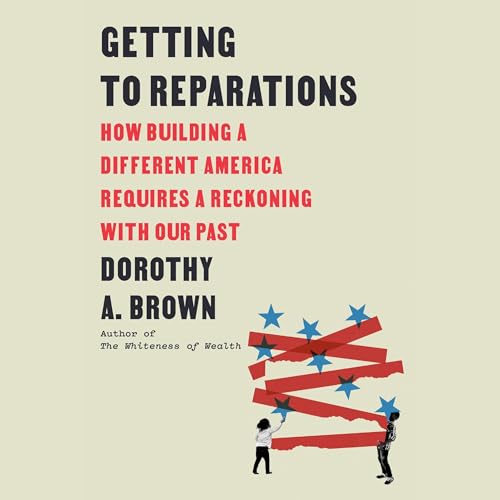
Getting to Reparations
How Building a Different America Requires a Reckoning with Our Past
Impossibile aggiungere al carrello
Puoi avere soltanto 50 titoli nel carrello per il checkout.
Riprova più tardi
Riprova più tardi
Rimozione dalla Lista desideri non riuscita.
Riprova più tardi
Non è stato possibile aggiungere il titolo alla Libreria
Per favore riprova
Non è stato possibile seguire il Podcast
Per favore riprova
Esecuzione del comando Non seguire più non riuscita
8,03 € per i primi 30 giorni
Offerte di stagione
0,99 €/mese per i primi 3 mesi
L'offerta termina il 28 dicembre 2026.
Dopo 30 giorni (60 per i membri Prime), 9,99 €/mese. Puoi cancellare ogni mese
Risparmia più del 90% nei primi 3 mesi.
Ascolta quanto vuoi, scegliendo tra migliaia di audiolibri e serie originali inclusi.
Scarica il tuo audiolibro e ascolta offline, senza interruzioni
Rinnovo automatico a 9,99 €/mese dopo 3 mesi. Disdici mensilmente. L'offerta termina il 28 dicembre 2026.
Dopo esserti registrato per un abbonamento, puoi acquistare questo e tutti gli altri audiolibri nel nostro catalogo esteso, ad un prezzo scontato del 30%
Ottieni accesso illimitato a una raccolta di oltre migliaia di audiolibri e podcast originali.
Nessun impegno. Cancella in qualsiasi momento e conserva tutti i titoli acquistati.

Getting to Reparations
Letto da:
Dorothy A. Brown
Acquista ora a 11,47 €
-
Letto da:
-
Dorothy A. Brown
-
Di:
-
Dorothy A. Brown
The idea of reparations is not a new or original one; it is one that is baked into American history.
When the District of Columbia Emancipation Act of 1862 went into effect, wealthy slaveowners like Margaret Barber were compensated for the loss of their enslaved workers. Barber received $9,000—an equivalent to $250,000 today. When a group of Italian immigrants were lynched in 1892, President Harrison compensated Italy a total of $25,000 for their deaths—an equivalent to almost $766,000 today. The Indian Claims Commission, an arm of the federal government, paid Indigenous Americans $818 million for underhandedly stealing their land in the eighteenth and nineteenth centuries—an equivalent to almost $350 billion today.
Dorothy A. Brown addresses the glaring question: if reparations can be achieved for others, why not for Black Americans? If lynching can be remedied for Italian immigrants, and slaveholders compensated for losses associated with abolition and emancipation, then the government’s failure to provide such remedies to Black communities harmed by similar violence, loss, and destruction is long overdue. The fight for reparations is truly a fight for the soul of America, to produce the country our founding fathers idealized but never achieved.
Getting to Reparations makes a logical and necessary case for reparations for Black Americans. It lays out a path as to how we might achieve this, built on the frameworks used throughout U.S. history by the government to pay restitution. It is now time to do the same for America's Black population.
adbl_web_anon_alc_button_suppression_t1
Recensioni della critica
“Dorothy Brown is offering oxygen to a democracy choking on lies, misdirection, and failing promise. Rather than merely describe this nation’s racist doctrine, Professor Brown offers a sober prescription. Sober not because it is hard—although it will be hard—but because making good on the nation’s debt to Black Americans is imminently doable. Getting to Reparations is the perfect mix of bold vision and practical strategy. Compelling stories call us to action while Brown’s deft guidance guides our way forward.”—Tressie McMillan Cottom, author of the National Book Award finalist Thick
“The incredible thinker and legal scholar Dorothy Brown does it again. With her clear prose and treasure trove of evidence, Brown challenges everyone who ever thought of reparations as a pipe dream and confronts them with a stellar argument and a rich analysis of the law. This book presents a pathway to reparations that is not only historically grounded but also legally rich in exposing the critical histories that must be studied and understood in order to move our recalcitrant nation toward an honest assessment of the debts that are owed and the harms that can never be fully repaired. A devastating and commanding read for anyone who wishes to create a better world and establish the foundations of a just future.”—Marcia Chatelain, author of the Pulitzer Prize–winning book Franchise
“Legal scholar Dorothy Brown has written a powerful book for anyone who questions seeking all forms of reparations for African Americans. Once a skeptic, she details in vivid prose previous chapters of governmental reparations in the United States and lays out a plan for doing so for Blacks. At this moment, a critical read.”—Dr. Earl Lewis, Thomas C. Holt Distinguished University, Professor at the University of Michigan
“A bracing history . . . A cogent argument for putting long-overdue dollars on the table to compensate for injuries past and present.”—Kirkus Reviews
“The incredible thinker and legal scholar Dorothy Brown does it again. With her clear prose and treasure trove of evidence, Brown challenges everyone who ever thought of reparations as a pipe dream and confronts them with a stellar argument and a rich analysis of the law. This book presents a pathway to reparations that is not only historically grounded but also legally rich in exposing the critical histories that must be studied and understood in order to move our recalcitrant nation toward an honest assessment of the debts that are owed and the harms that can never be fully repaired. A devastating and commanding read for anyone who wishes to create a better world and establish the foundations of a just future.”—Marcia Chatelain, author of the Pulitzer Prize–winning book Franchise
“Legal scholar Dorothy Brown has written a powerful book for anyone who questions seeking all forms of reparations for African Americans. Once a skeptic, she details in vivid prose previous chapters of governmental reparations in the United States and lays out a plan for doing so for Blacks. At this moment, a critical read.”—Dr. Earl Lewis, Thomas C. Holt Distinguished University, Professor at the University of Michigan
“A bracing history . . . A cogent argument for putting long-overdue dollars on the table to compensate for injuries past and present.”—Kirkus Reviews
Ancora nessuna recensione