

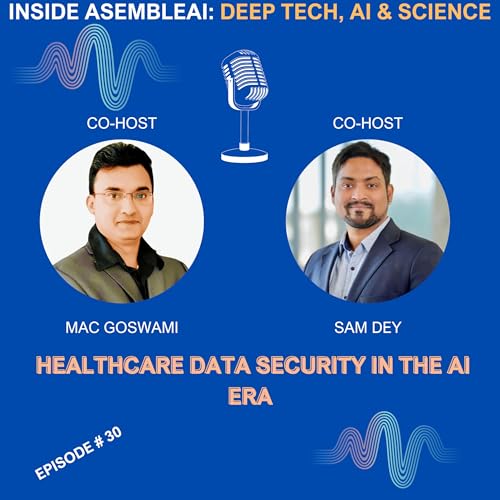
EP 30: Healthcare Data Security in The AI Era
Impossibile aggiungere al carrello
Rimozione dalla Lista desideri non riuscita.
Non è stato possibile aggiungere il titolo alla Libreria
Non è stato possibile seguire il Podcast
Esecuzione del comando Non seguire più non riuscita

EP 30: Healthcare Data Security in The AI Era
-
Letto da:
-
Di:
A proposito di questo titolo
In 2024, a single cyber attack exposed the medical records of 190 million Americans. As healthcare organizations rush to adopt AI—with 38% now using it regularly—a new crisis is emerging: how do we harness AI's transformative power while protecting the most sensitive data we possess? This episode tackles the critical intersection of AI innovation and healthcare data security, where the stakes couldn't be higher.
Sam and Mac reveal alarming statistics that healthcare executives can't afford to ignore: AI privacy incidents surged 56.4% in 2024, with 72% of healthcare organizations citing data privacy as their top AI risk. The average healthcare breach now costs $11.07 million per incident, yet only 17% of organizations have technical controls in place to prevent data leaks. The math is terrifying—and the problem is accelerating.
The conversation explores how AI fundamentally changes the threat model in healthcare. Unlike traditional software that processes data according to fixed rules, AI models can unintentionally retain sensitive patient information from training data, creating new vulnerabilities that standard security practices weren't designed to address. Shadow AI—unauthorized AI tools used by employees handling sensitive data—poses massive compliance risks that most organizations haven't even begun to map.
But this isn't just a doom-and-gloom episode. Sam and Mac outline emerging solutions that could reshape how healthcare handles AI and data security. Federated learning allows AI models to train across multiple institutions without patient data ever leaving its original location, enabling collaboration without exposure. Synthetic data can mimic real patient populations for AI training without using actual patient information, dramatically reducing privacy risks while maintaining analytical value.
Looking forward, the episode emphasizes that stronger regulations and compliance practices aren't obstacles to AI adoption—they're prerequisites for sustainable innovation. Patient trust is healthcare's most valuable asset, and once lost through a major AI-related breach, it may be impossible to recover. The organizations that will thrive in the AI era are those that treat data protection not as a compliance checkbox but as a competitive advantage and moral imperative.
Key topics covered:
• The 2024 cyber attack exposing 190 million American medical records
• Why 72% of healthcare organizations cite data privacy as their top AI risk
• The 56.4% surge in AI privacy incidents involving PII (personally identifiable information)
• Healthcare breach costs: $11.07 million average per incident
• Shadow AI risks: unauthorized tools handling sensitive patient data
• Why only 17% of organizations have adequate technical controls
• How AI models unintentionally retain sensitive training data
• Federated learning: training AI without data leaving institutions
• Synthetic data: mimicking real populations without using actual patient information
• The regulatory landscape and need for stronger compliance frameworks
• Balancing innovation velocity with responsible AI practices
• Privacy-preserving techniques: differential privacy and secure multi-party computation
• Patient trust as healthcare's most critical asset in the AI era
• Practical governance frameworks for healthcare AI implementation
This episode is essential listening for healthcare executives navigating AI adoption, data security professionals protecting sensitive information, technology leaders implementing AI systems, and anyone concerned about the privacy implications of AI in medicine. Sam and Mac cut through the hype to deliver actionable insights on one of healthcare's most pressing challenges: how to innovate responsibly in an era where a single breach can expose hundreds of millions of records.